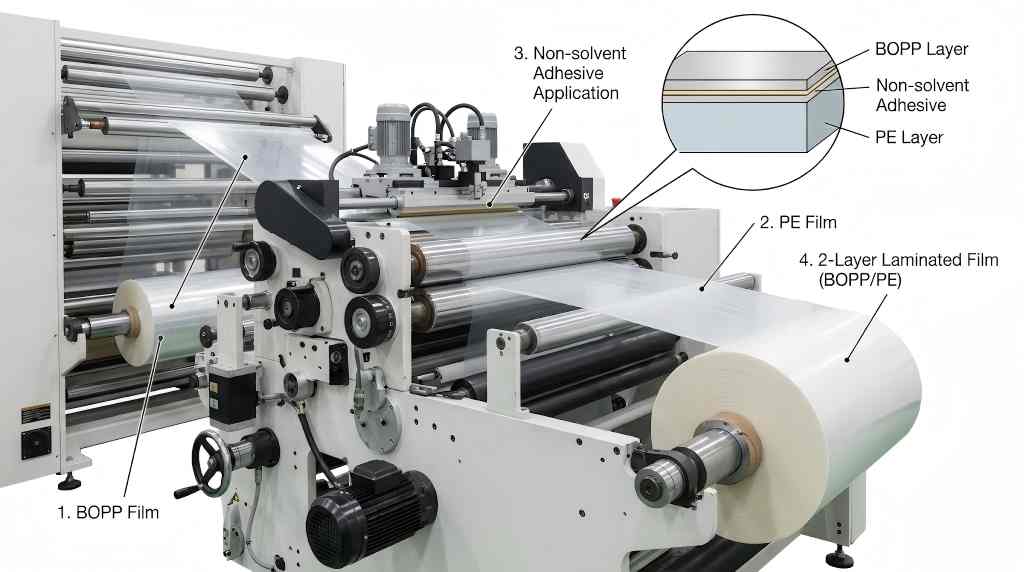


While the discussion of PET vs. BOPP often centers on 2-layer lamination, the principles extend directly into triplex production. When selecting the outer layer of a 3-layer structure, the choice between PET and BOPP carries profound implications:
Barrier Properties
PET offers excellent oxygen barrier (low OTR), making it the superior choice for preventing rancidity in fatty foods. BOPP offers high moisture barrier (low WVTR) but inferior oxygen barrier. For triplex structures requiring both, a metallized PET film as the middle layer is preferred.
Thermal Stability
PET's melting point (~260°C) allows it to act as a heat-resistant shield, enabling the inner PE layer to melt and seal without the outer layer shrinking. BOPP melts at ~165°C, requiring much tighter temperature control on the packaging line to avoid "burn-through" or thermal shrinkage. In a triplex machine, this thermal gap means PET-based structures can tolerate more aggressive processing conditions.
Dimensional Stability and Tension Behavior
PET is dimensionally stable and does not stretch significantly under standard operating tensions, making it the preferred choice for high-speed 3-layer lamination where consistency is the priority. BOPP, with its higher modulus of elasticity, stretches easily under tension. If rewinding tension is too high, BOPP stretches and then "rebounds" after tension release, leading to curl—a defect that renders the film unusable on automatic pouch-making machines.
https://www.sinstarsl.com/pet-....pe-vs-bopp-pe-2-laye