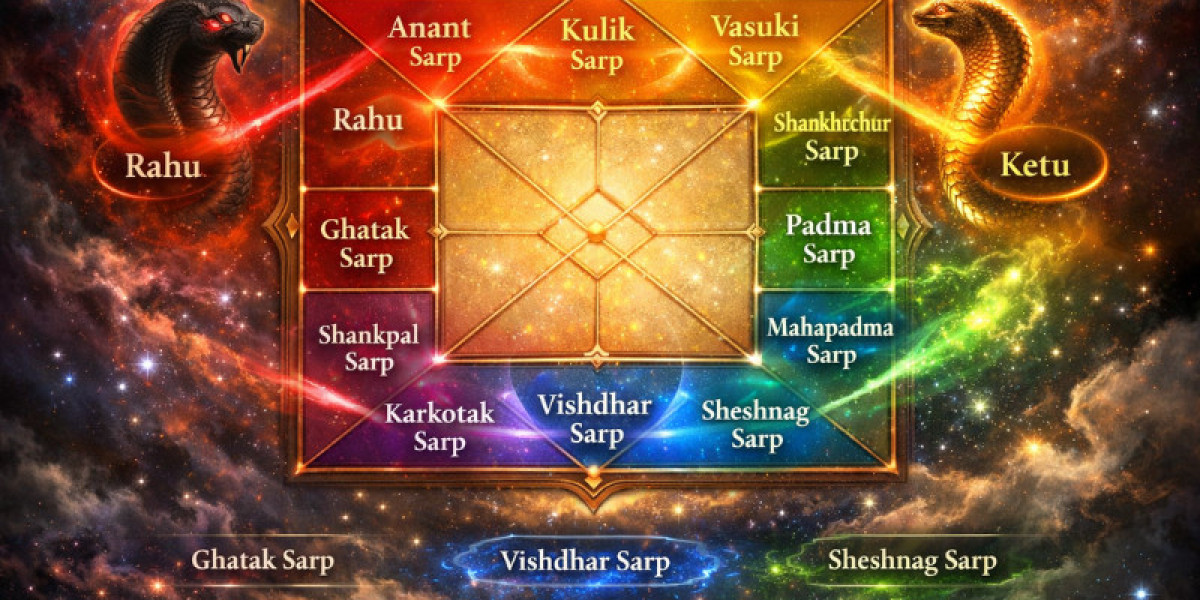

Why do some people face repeated delays, inner restlessness, or sudden life changes despite consistent effort? This question often leads seekers toward astrology and, more specifically, toward the concept of Kaal Sarp Dosh. Most readers want a clear explanation of its types, how they are formed, and what they signify in practical life terms. Kaal Sarp Dosh is considered to be present when all planets in a birth chart are positioned between Rahu and Ketu. Its different forms depend on the houses occupied by Rahu and Ketu, and each form is linked with specific life experiences and karmic lessons.
Understanding Kaal Sarp Dosh in Astrology
In Vedic astrology, Rahu and Ketu are known as shadow planets that signify karmic imbalance, sudden events, and deep psychological transformation. When all other planets fall within the axis formed by these two nodes, the birth chart is believed to reflect a powerful karmic pattern. This planetary alignment forms the foundation for the Types of Kaal Sarp Dosh, each of which is traditionally associated with delays, emotional pressure, inner conflict, or a sense of restriction in specific areas of life, depending on the houses involved.
However, it is important to understand that this dosh is not universally interpreted as negative. Many astrologers associate it with delayed success, where achievements come after perseverance, discipline, and maturity rather than immediate rewards.
Basis for Classifying the Types